Once again, it seems, as was the case last year, Apple likely won’t be doing a second launch event this fall as a follow-up to last month’s announcements. And once again, as was the case last year, the company’s competitors are stepping into the breach. Amazon and Microsoft both unveiled new products in late September, with Google following this week. And predating them all was drama involving management shuffles between the two Seattle, WA area competitors.
On Monday, September 18, Microsoft announced that Panos Panay, the company’s Executive VP and Chief Product Officer, specifically the management head for both Windows and the Surface product line, was leaving. This seemingly abrupt news was surprising for multiple reasons:
- Panay had been at the company for nearly 20 years
- He was the longstanding public “face” of both Surface and Windows 11, and
- As of a month earlier, Microsoft had already scheduled a launch event covering both product lines for later that very same week (Thursday, September 21st, to be precise)!
Rumors began circulating almost immediately that Panay was headed for Amazon, a company with its own scheduled event that same week, one day earlier, to be exact. Panay was a subsequent no-show at Amazon’s Wednesday, September 20 event, however, and he didn’t appear at his former employer’s event one day later, either (unsurprisingly at that point). It took until the following Tuesday, September 26th for Amazon to make the scuttlebutt official. Panay will be inheriting the Amazon Senior VP of Devices and Services job previously held by Dave Limp, who’d announced in mid-August that he was retiring but apparently later had a change of heart: on Monday, September 25th Blue Origin, Amazon founder and Executive Chairman Jeff Bezos’s rocket company, announced that Limp was taking over its CEO role.
Normally, I wouldn’t devote this much cyber-ink to corporate headcount shuffles, but in this case, I think they’re reflective of product line maturation (or, if you prefer, ossification) at both companies. Amazon’s had a long string of undeniable successes with its various devices—Kindle e-book readers, Echo smart speakers and displays, Fire tablets and media streamers, etc.—but those product categories are well established at this point, and getting consumers to upgrade beyond what they already own is therefore increasingly challenging. To wit, yours truly is still happily using first-generation Echos in his home, for example, along with an aptly-named more-than-a-decade-old Kindle Keyboard 3G, whose “Whispernet” cellular data service has been shut down but still syncs just fine over Wi-Fi.
Companies Amazon has bought—Blink and Ring security equipment, for example, or Eero’s wireless networking gear—are maturing, too, and the proposed iRobot acquisition is stuck in regulatory purgatory. Amazon’s own consumer robot efforts have gone nowhere so far; the company’s Vice President in charge of such products, Ken Washington, left back in May. The result of all this morass? Widespread employee morale loss, particularly in the Lab126 R&D division…so says the gossip, at least.
Things aren’t notably better at Microsoft, apparently. Keep in mind that until a decade (and a year) ago, the company’s computing hardware ambitions (not counting multiple game console generations and its commendable but ultimately unsuccessful Zune portable music players, for example) were restricted to peripherals such as keyboards, mice and webcams. That all changed when the company decided to compete against its licensees with the Surface product line beginning in 2012, with the branding further expanding to smartphones starting in 2019.
Microsoft’s computing and communications hardware ideas were innovative, especially at first. And although the company never achieved market share dominance, I’d argue that this was never the primary impetus; instead, it was to spur the entire industry forward. Still, generational innovation has slowed in recent years, a topic into which I’ll delve in more detail in a Surface Pro case study piece scheduled for next month. And although the company’s Surface Duo smartphone product line was compelling from a hardware standpoint, lingering software bugs and broader feature set limitations hobbled its aspirations.

Both companies’ diminished fortunes were on full display at their late-September events. Amazon, for example, unveiled a raft of iterative upgrades, like:
- Second-generation audio-supportive glasses
- Next-generation Fire TV Stick media streamers, along with the company’s first streaming-inclusive soundbar
- A wall-mounted Fire Tablet derivative, the Echo Hub, along with a redesigned Echo 8 smart display (that costs even more if you want to use it to display pictures ???!!!)
- Several child-tailored product variants
- A next-gen Ring security camera with added radar depth-sensing capabilities, and
- Next-gen Eero mesh networking gear with Wi-Fi 7 speed and a substantial price tag uptick to match (that said, I was admittedly impressed by the dual 10GbE WAN ports!)
But the company devoted plenty of airtime to services and software upgrades that are applicable to its existing products, too, such as:
- A generative AI-enhanced update to the Alexa voice assistant service, which (quoting from The Verge’s coverage) “can understand conversational phrases and respond appropriately, interpret context more effectively, and complete multiple requests from one command”, as well to as the Fire TV.
- Various accessibility enhancements for some members of its Fire tablet family
- Alexa Emergency Assist, which allows users to call for help from an Echo (for an incremental per-month price) and also bundles the formerly-free Alexa Guard smoke and carbon monoxide alarm detection and glass break sound detection features, and
- The coming-soon abilities for newer Echo smart speakers to automatically control smart lights and for you to more generally “map” your smart home’s various devices.
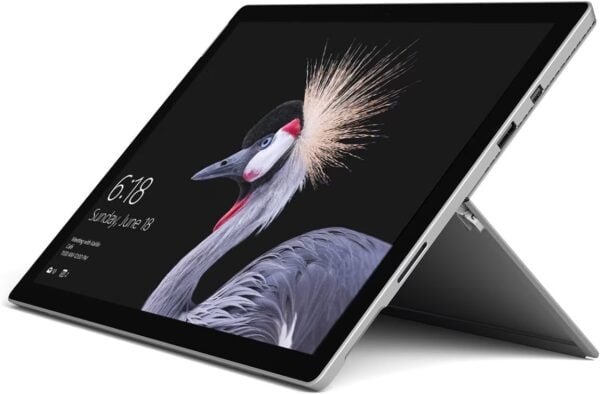
Microsoft’s day-later event was comparably ho-hum from a hardware standpoint, comprising newer-generation x86 CPU-and-chipset and GPU upgrades to existing platforms, with little enhancement beyond what feature upticks came along for the silicon-update ride:
- The Surface Laptop Studio 2
- Surface Laptop Go 3
- Surface Go 4 (in a comparatively muted unveil manner), and
- Surface Hub 3 collaborative touchscreen
Equally interesting to me was what hardware didn’t get upgraded at the event, such as:
- The Surface Pro 9 line, a year old at this point with no updates in sight
- A rumored Arm-based variant of the Surface Go, which also was a no-show. After delivering two generations’ worth (not counting the initial Surface RT) of Arm-based “X”-differentiated variants of the Surface Pro, Microsoft had merged the product lines under common “Surface Pro 9” naming a year ago, with the Arm-based variants alone in supporting cellular data capabilities. Third-party developers seemingly remain slow to embrace Windows-on-Arm, however; my first-generation Surface Pro X (which dates from October 2019), for example, got a public beta of the Dropbox client just a few weeks ago in late August 2023, which has made it eminently more usable to me. I suspect this sloth-like (for understandable reasons, mind you) Arm embrace by the Windows ecosystem is at least in part behind the slow-motion platform rollout. And…
- No Surface Duo 3 (not that I was admittedly surprised with this particular omission)
And Microsoft also ended up devoting a notable percentage of the total event runtime to services and software upgrades equally applicable to its existing products. For example:
- The OpenAI GPT-4-based “Copilot” AI assistant, built into Windows 11 and also accessible by other products such as Office 365, the Edge browser and Bing Search
- Speaking of OpenAI…DALL-E text-to-image generative AI support in Bing Chat, and
- Passkey support in Windows 11 as an alternative to traditional passwords
Speaking of smartphones, what did Google announce this week? I’m writing this shortly after the conclusion of the Wednesday morning, October 4 hardware-centric launch event:
I suspect that more info will leak out after attendees share their initial hands-on impressions, followed by developers’ insights. So, keep an eye on the comments section of this post for more of my thoughts, along with potential follow-up blog posts to come. Still, what I’ve learned thus far is already pretty interesting.
Pixel 8 and Pixel 8 Pro
When I submitted my last-month-published writeup on the Google Pixel 7 product line to EDN in mid-August, I already had a good idea (based both on in-progress, presumably inventory-clearing promotions on existing products, and on past history) that the company’s next-generation smartphone product line would shortly be arriving. And when a bunch of Pixel 8 family images “coincidentally” (this has also happened before) leaked, then were officially published, ahead of Apple’s iPhone 15 family unveiling, my confidence further increased.
I was right. Here are some initial observations (this page enables you to easily compare various past-and-current product offerings):
- The Pixel 8 Pro and precursor Pixel 7 Pro have the same dimensions and screen sizes. The Pixel 8, on the other hand, is slightly smaller in all respects than its Pixel 7 predecessor, although it houses a slightly higher capacity battery
- Both product variants are based on Google’s latest Tensor G3 SoC, with unannounced clock speeds (and unknown-if-any speed, core count or other variances between “standard” and “Pro” phone versions). That said, a leak from a couple of days ago reveals the following claimed specs for (at least) the Pixel 8 Pro variant of the SoC:
- A 1+4+4 core layout, versus 2+2+4 in the prior two Tensor SoC generations.
- A 4 nm process fabrication foundation
- Main (“big”) core: a 2.91 GHz Arm Cortex-X3 (versus two 2.85 GHz Arm Cortex-X1s on the Tensor G2)
- Secondary cores: Four 2.37 GHz Arm Cortex-A715 (versus two 2.35 GHz Arm Cortex-A78s on the Tensor G2)
- Low-power (“little”) tertiary cores: Four 1.7 GHz Arm Cortex-A510s (versus four 1.80 GHz Cortex-A55s on the Tensor G2)
- GPU: A 10-core “Immortalis” variant of the Mali-G715 (versus the Mali-G710 MP7 on the Tensor G2)
- Also recently leaked were claimed GeekBench 6 results. The Tensor G3 in the Pixel 8 Pro scored 1760 (single-core) and 4442 (multi-core score). The Tensor G3 in the standard Pixel 8, comparatively, scored 1563 (single-core) and 4159 (multi-core), suggestive of a peak clock speed differential between the two variants. For comparison’s sake, here are detailed screenshots I just took of the Tensor G2 in my Pixel 7 also running GeekBench 6. Note, however, that my two smartphones are still running Android 13; I haven’t gotten my Android 14 upgrade “push” notification. Conversely, since the Pixel 8 models won’t be available until next week, I assume they’re running Android 14 out of the box.


- As before the “Pro” model comes with 12 GBytes of RAM, versus 8 GBytes in the standard Pixel 8 variant.
- Google talked at length about the various AI enhancements (generative and otherwise) delivered by the new product family versus predecessors. Notably, the company focused its performance-related comparisons specifically on the “Pro” model, which I suspect has to do both with the aforementioned clock speed and RAM allocation enhancements.
- Max nonvolatile storage memory capacity on the Pixel 8 Pro is now 1 TByte, versus 512 Mbytes on the Pixel 7 Pro.
- The Pixel 8 Pro adds a back-side temperature sensor to the offered sensor-fusion mix. As a more general comment, Google is doing much more this time to differentiate between the standard and Pro smartphone versions than just historical size and camera variances.
- Speaking of cameras, the two- (standard) and three-camera (Pro) clusters have been iteratively improved in metrics such as max aperture (for low-light image capture) and pixel count (notably for the ultrawide camera in the Pixel 8 Pro vs Pixel 7 Pro).
- Software update support bumps up from five years to seven years. As I’ve mentioned in past coverage, until the Pixel 6 generation this was only three years. Newer models, presumably due in no small part to Google’s increased control of its own silicon-and-driver-software destiny, still only support three years of upgrades for primary operating systems, but five years for bug fixes and the like. But this time the seven-year quote also includes core operating systems, which is frankly awesome.
Pixel Watch 2
I hadn’t yet had the chance to share that a couple of weeks ago I took advantage of one of the aforementioned inventory-clearance promotions to pick up a first-generation Google Pixel Watch. Not only was it marked down $60 from the usual MSRP (from $399 to $339 for the LTE model), it came with two years’ worth of limited (vs a full-service subscription) but still quite useful Google Fi cellular data service at no extra cost. I’ve largely (albeit not completely) enjoyed the experience of using the Pixel Watch so far; as long-time readers may remember, I’ve periodically tried out smartwatches based on Android Wear, later rebranded as Wear OS, and this version is by far the best yet. Stand by for a full review to come in a future blog post.
Unsurprisingly, however, I’ve already grown weary of the necessity to tether the Pixel Watch to a charger roughly every 24 hours, in contrast to the week-or-longer battery life delivered by my Garmin and Withings alternatives. Therefore, I’m very interested to see some long-term usage reports on the 2nd generation version of Google’s smartwatch design, also released this week:
Specifically, it migrates from a 10nm-fabricated dual-core Samsung Exynos 9110 to Qualcomm’s quad-core, 4nm-based Snapdragon Wear 5100 SoC. Presumably, there’ll be a requisite associated performance boost, although I’ve got no beef with the snappiness of what I’m wearing right now. But although the Pixel Watch 2 still specs 24 hours of battery life, this time it’s with the display’s always-on option enabled. Granted the battery’s also slightly larger this time (306mAh vs 294mAh) but I’m guessing the SoC evolution is the key reason for the power consumption improvement here.
There are plenty of other tweaks to the Pixel Watch 2 design, many of them seemingly “lifted” from the Fitbit product line that Google acquired in January 2021, and most of them iteratively fairly modest in comparison to the processing-nexus upgrade. Nearing 2,500 words, for now I’ll let you read more about them elsewhere and save more in-depth absolute and comparative treatment of my own for my hands-on Pixel Watch 1 coverage to come. And until then, I of course also welcome your thoughts on today’s coverage in the comments!
—Brian Dipert is the Editor-in-Chief of the Edge AI and Vision Alliance, and a Senior Analyst at BDTI and Editor-in-Chief of InsideDSP, the company’s online newsletter.